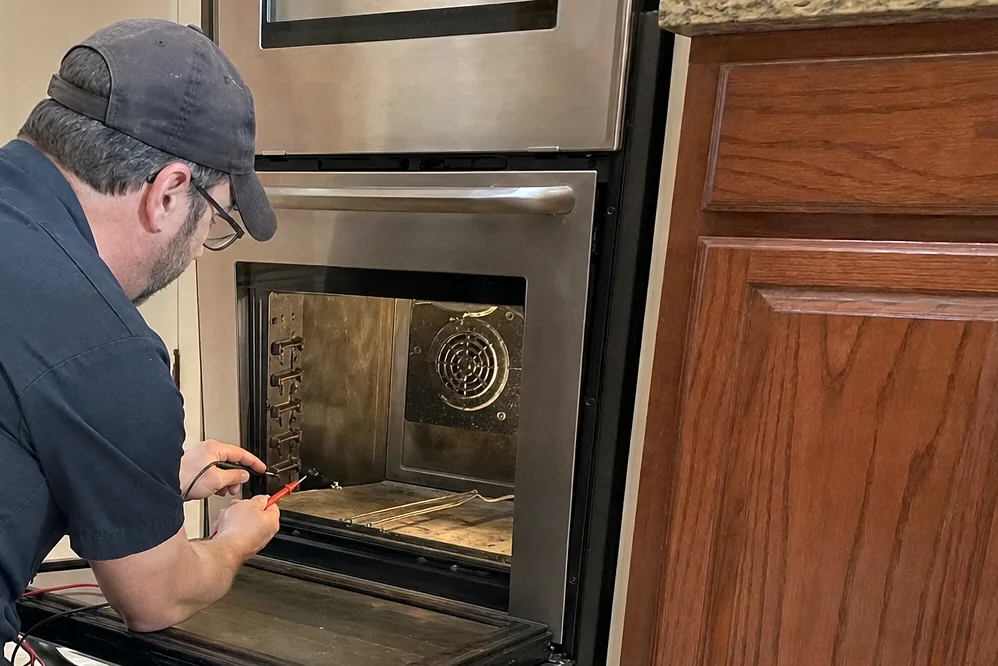
We would rather you did not need us
A diagnostic visit costs $80. A fair number of the calls we take are for conditions that are not appliance faults at all, and we would rather tell you that on this page than take the fee to tell you in person.
None of what follows involves opening an appliance, removing a panel, or going anywhere near gas or high voltage. If a check requires tools, it is not on this list.
Power, first, always
Switch the breaker off, wait a full minute, switch it back on. On hardwired appliances this is not the same as unplugging something, and some control systems latch a fault state that only clears on a genuine power cycle.
Check whether anything else in the kitchen changed at the same time. Two appliances behaving oddly in the same week is a supply story far more often than it is coincidence, and it points at the building rather than the machine.
If the failure followed a storm week or a utility outage, note that. This region averages around 68 thunderstorm days a year, and the timing is diagnostic information we cannot recover later.
Induction cooktops
Try a different pan. Induction needs ferrous cookware, and a pan that has warped, or a new pan with a thin magnetic layer, will read as no pan present. A refrigerator magnet on the base of the pan settles it in two seconds.
If one region of a large surface is dead and the rest works, note exactly which region. That maps onto specific boards and it genuinely shortens the diagnosis.
Ovens
If the oven is dead immediately after a self-clean cycle, note what was inside during the cycle and whether the cavity was heavily soiled. There is a whole article on this site about that fault and its cause.
If the complaint is baking rather than a hard failure, put an independent oven thermometer in the centre of the cavity, set 350, and let it stabilise. A number is worth more to us than any description, and it tells us on the phone whether we are looking at calibration or at airflow and door sealing.
Check the door seal by hand along its whole run, and look at whether the door sits square to the frame. A gap at the top corners explains long preheats, uneven browning and a cooling fan that runs forever.
Dishwashers
Pull the filter at the bottom of the tub, rinse it under a tap, and put it back. It is designed to be removed and it is almost never cleaned.
Take the spray arms off and hold them up to a light. Blocked jets are one of the most common causes of poor cleaning, especially on the upper and third racks, and a jet blocked by a seed or a fragment of label costs nothing to clear.
If water is standing in the bottom, look at whether it sits above or below the filter, and think about whether anything under the sink changed recently. A disposer fitted without its knockout plug removed stops a dishwasher draining from the day it is installed, and that is not a fault in the appliance.
Refrigeration
Check the water filter date. A filter well past its interval restricts flow, and restricted flow is the direct cause of hollow and undersized ice cubes.
Check that the vents inside the compartment are not blocked by packed food, and that the door is closing fully against its seal. On a panel-ready column, a heavy custom panel that has drifted out of alignment will hold the door a fraction open.
Ventilation
Run the hood filters through a dishwasher. Reduced airflow with a healthy motor is very often nothing more than a year of grease.
If the blower hums but does not spin up, note that specifically. It is a different fault from a blower that does nothing at all, and on coastal installations it is frequently a run capacitor rather than a motor.
What to tell us when you book
The appliance type and roughly how old it is. What it does and what it does not do, in that order. When it started and what else was happening at the time. Whether the appliance is built into cabinetry and whether the opening was original or retrofitted. What the floor is in front of it, if we will be pulling a column forward. And whether the property is gated or has access arrangements, because that is the detail that most often costs everybody twenty minutes.
We book Monday to Friday 8am to 6pm and Saturday 9am to 4pm. We do not run a 24-hour or emergency line, and messages left outside those hours are answered the next working morning. The diagnostic is a flat $80, credited toward the repair when you approve the work, and a written estimate comes before any part is ordered or fitted.